

Body Dysmorphic Disorder
Learning to Break Free from Appearance-Related Anxiety
What Is Body Dysmorphic Disorder (BDD)?
Do you find yourself spending significant amounts of time worrying about your appearance, focusing on certain features, or feeling distressed by how you believe you look? Perhaps you repeatedly check mirrors, compare yourself to others, seek reassurance, or avoid situations because of concerns about how others might perceive you.
You may recognize that your appearance concerns have become excessive, yet you find it incredibly difficult to stop thinking about them. Or perhaps you feel convinced that a particular feature is flawed and feel a strong need to change it to feel more confident, comfortable, or happy.
If these experiences sound familiar, you may be struggling with Body Dysmorphic Disorder (BDD).
BDD is a mental health condition characterized by persistent, distressing preoccupations with one or more perceived flaws in your physical appearance. These perceived imperfections may be minor and not noticeable to others, yet they can feel extremely significant to you and difficult to ignore.
BDD is much more than ordinary dissatisfaction with your appearance. It can affect how you see yourself, how you feel around other people, and how you participate in everyday activities.
You may spend considerable time examining, analyzing, hiding, or trying to correct the features that concern you. Although these efforts are intended to help you feel better, they may only provide temporary relief and actually cause your appearance concerns to be even more pressing and overwhelming.
One of the most important things I hope to help you understand is that BDD is not about vanity or superficiality.
Your distress is real, and the thoughts, feelings, and urges associated with BDD can be incredibly difficult to manage.
The encouraging news is that BDD is treatable. Through evidence-based Cognitive Behavioral Therapy (CBT) and Exposure and Response Prevention (ERP), you can learn new ways to respond to appearance-related concerns, reduce distressing patterns of thinking and behavior, and develop greater confidence in navigating your daily life.

What BDD Can Look Like?
BDD can involve concerns about nearly any aspect of your physical appearance. Some common areas include:
Skin: Concerns about acne, blemishes, scars, wrinkles, pores, skin texture, or complexion.
Facial Features: Preoccupation with the size, shape, or symmetry of the nose, eyes, lips, chin, jawline, or other facial features.
Hair: Concerns about hair thinning, hair loss, hairlines, texture, or the amount and distribution of facial or body hair.
Body Shape and Proportions: Worries about the size, shape, or proportions of particular body areas, including the stomach, arms, legs, chest, or other features.
Symmetry and Perfection: A strong focus on features appearing uneven, asymmetrical, disproportionate, or not quite right.
Muscle Dysmorphia: A form of BDD in which you may become excessively concerned that your body is too small, insufficiently muscular, or not adequately developed, even when others perceive you as muscular. This can involve excessive exercising, rigid dietary routines, body checking, or avoidance of situations where your body may be visible.
Some people experience concerns focused on only one feature, while others can worry about multiple areas or find that their concerns shift over time.
People with BDD also can differ in how strongly they believe their appearance-related concerns are accurate. Some recognize that their thoughts may be exaggerated, while others feel completely convinced that the perceived flaw is real and noticeable.
Fortunately, you do not have to recognize your concerns as excessive in order to benefit from seeking help.
Regardless of the particular feature or concern, BDD can create a persistent feeling that something about your appearance needs to be corrected before you can feel comfortable, accepted, or confident.
When Does Appearance Anxiety Become a Diagnosable Disorder?
According to the Diagnostic and Statistical Manual of Mental Disorders (DSM-5-TR), BDD is classified as an Obsessive-Compulsive and Related Disorder.
The diagnosis involves several important features:
Appearance-Related Preoccupations:
You experience persistent concerns about one or more perceived flaws in your appearance that are not observable or appear slight to others. These thoughts are often time-consuming, sometimes occupying an hour or more of your day.
Significant Distress or Interference:
Your appearance concerns cause meaningful emotional distress or interfere with important areas of your life, including work, school, relationships, or everyday activities.
Repetitive Behaviors or Mental Rituals:
At some point, you engage in repetitive behaviors in response to your appearance concerns, such as mirror checking, excessive grooming, reassurance seeking, or mentally comparing yourself to others.
Diagnostic Considerations:
Your symptoms are not better explained by an eating disorder when the concerns are specifically focused on body fat or weight.
There is also a less common BDD-related presentation sometimes called BDD by proxy, in which a person becomes excessively preoccupied with perceived imperfections in someone else's appearance, such as a partner or family member.
Understanding the BDD Cycle: Why Appearance Concerns Become So Persistent
One of the most frustrating aspects of BDD is that the very things you do to feel better about your appearance can unintentionally increase your distress and the severity of BDD symptoms.
Imagine noticing something about your appearance that makes you uncomfortable. You might begin worrying that others will notice it, judge you negatively, or view you differently because of it. Your distress in turn triggers the urge to check in the mirror, examine photos, ask others for reassurance, compare yourself with others, or try to conceal the feature that concerns you – all in an effort to feel better.
Sometimes these behaviors bring temporary relief. You may feel better for a few moments. However, the relief doesn't last. Instead, you may notice something else, doubt what you saw, or feel the need to check again. Over time, this increased attention makes the perceived flaw feel even more noticeable, important, and threatening.
This creates a self-reinforcing cycle:
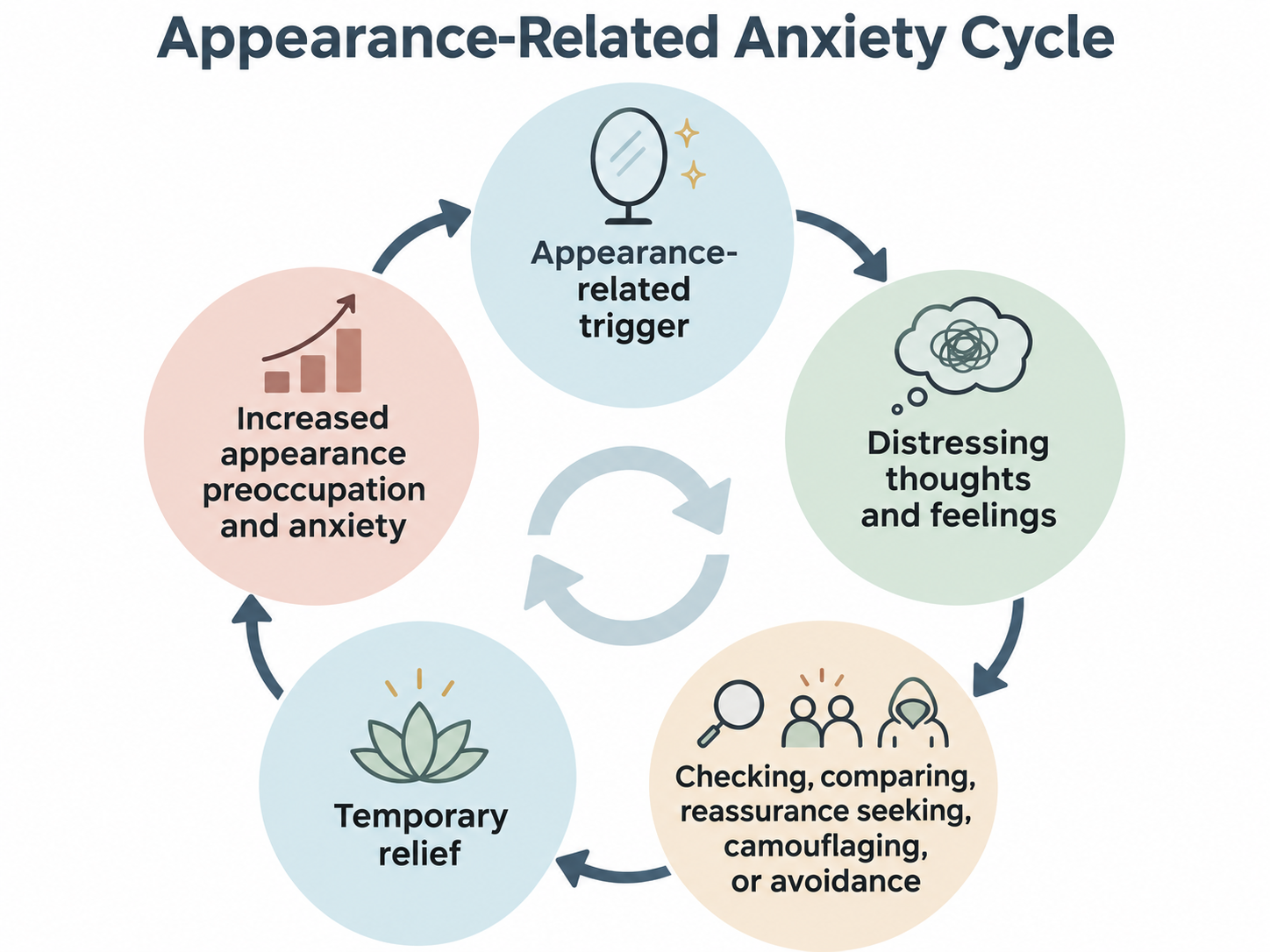
Common behaviors that fuel the BDD cycle include:
Repeatedly checking mirrors, photographs, or reflections
Avoiding mirrors or having photographs taken
Comparing your appearance to others in person or on social media
Seeking reassurance about how you look
Excessive grooming, makeup application, or changing clothes
Using clothing, hairstyles, or body positions to camouflage or conceal perceived flaws
Mentally reviewing how you looked or how others may have reacted to you
Seeking repeated cosmetic consultations or procedures in hopes of finding lasting relief
Avoiding social activities, relationships, or experiences where you worry your appearance might be noticed
The encouraging news is that these patterns can change.
Cognitive Behavioral Therapy (CBT) is an evidence-based treatment approach that can help you understand and change the thinking and behavioral patterns that maintain BDD. Our work focuses on helping you develop a healthier, more flexible relationship with your appearance-related thoughts and feelings.
We will begin by exploring your particular experiences with BDD, including the situations that trigger your concerns, the thoughts and beliefs that follow, and the behaviors you currently use to handle distress. Together, we will develop an individualized treatment plan that helps you build practical skills, challenge unhelpful patterns, and gradually approach situations that you may have been avoiding.
Developing Greater Cognitive Flexibility
BDD can influence not only what you notice about your appearance but also how you interpret what you notice.
For example, you might find yourself thinking:
"Everyone is going to notice this flaw."
"If I don't look right, people will judge me."
"I can't feel confident until I fix this."
"I need to be certain that I look okay before I go out."
"If someone notices my appearance, they will think less of me."
These thoughts may feel like facts, even when they involve assumptions, predictions, or rigid expectations.
Through CBT, we can work together to recognize these patterns and develop greater cognitive flexibility. You can learn to challenge the importance you assign to particular appearance concerns, recognize when you're making assumptions about what others think, and consider more balanced perspectives.
We may also explore deeper beliefs about appearance, self-worth, acceptance, and perfectionism.
Most importantly, you can begin to recognize that your value as a person, your ability to connect with others, and your capacity to live the life you wish to have do not depend on a particular appearance standard.
Exposure and Response Prevention (ERP): Breaking the BDD Cycle
Another central component of CBT for BDD is Exposure and Response Prevention (ERP), an evidence-based approach that helps you gradually face appearance-related fears while changing the behaviors that maintain anxiety.
Learning to See the Bigger Picture: Mirror Retraining and Attention Skills
Another important part of CBT for BDD involves changing how you direct your attention toward yourself and your appearance.
When you struggle with BDD, your attention may become narrowly focused on specific details or perceived imperfections.
You might repeatedly examine one area of your face, zoom in on photographs, or scrutinize your reflection from different angles. This intense focus can make the area feel increasingly noticeable and distressing.
At other times, you may avoid mirrors altogether because seeing your reflection feels too uncomfortable.
In treatment, we work on developing healthier ways of relating to mirrors, photographs, and your appearance more generally.
This may include practicing a more balanced, neutral way of observing your reflection rather than examining particular features or judging what you see.
We can also work on shifting your attention outward, helping you become more engaged with life - conversations, activities, and your surroundings - rather than remaining focused on monitoring your appearance or questioning how others perceive you.
Developing Self-Compassion and a More Flexible Sense of Self-Worth
For many people, appearance concerns become closely connected to self-esteem and a sense of personal worth. An important part of our work may involve helping you develop a more compassionate and flexible relationship with yourself. This does not mean you must love every aspect of your appearance or feel confident all the time. Instead, you can learn to treat yourself with greater kindness, reduce harsh self-judgment, and recognize that your identity and value extend far beyond your physical appearance.
We can work toward building a sense of self-worth grounded in your relationships, interests, strengths, values, and the many qualities that make you who you are.
My Promises to You
I will not force you into situations or expect you to take steps before we've worked together to prepare you for them. My goal is to help you feel supported, informed, and actively involved throughout the process.
I won't ask you to do something that I wouldn't reasonably do myself, and I won't force you to engage in exercises that we haven't collaboratively discussed and prepared for.
My role is to guide, encourage, and support you as you learn to approach situations with greater flexibility and confidence.
I hope to help you experience greater freedom from BDD, trust in your ability to manage difficult thoughts and feelings, and reconnect with the relationships, activities, and opportunities that matter most to you.