

Worry, Anxiety & Rumination
Learning to Break the Cycle of Worry and Overthinking
What Is Anxious Rumination?
Do you find yourself getting caught in repetitive thoughts, replaying conversations, analyzing situations, or worrying about what might happen in the future? Do you spend significant time trying to figure things out, make sense of your feelings, or find certainty about a situation, only to feel more anxious or overwhelmed?
If so, you may be experiencing anxious rumination, a pattern of repetitive thinking that can contribute to anxiety, stress, and emotional distress.
Rumination occurs when your mind repeatedly focuses on concerns, questions, or perceived problems without moving toward a helpful resolution. You might replay past experiences, question decisions you've made, anticipate potential problems, or analyze your thoughts and feelings in an effort to gain clarity or reassurance.
While it is natural to reflect on experiences and think through challenges, anxious rumination is different because of its excessive nature and how hard it is to stop it. Rather than helping you feel more confident or prepared, it can leave you feeling increasingly uncertain, mentally exhausted, and stuck.
How Rumination Fuels the Anxiety Cycle.
One of the challenging aspects of rumination is that it often begins with a positive intention: You're trying to solve a problem, prevent something bad from happening, or feel more certain and in control.
However, the more time you spend analyzing worries, the more important, threatening, or urgent it can begin to feel. Rather than resolving your anxiety, repeated mental review can strengthen your focus on the perceived threat and generate even more questions and concerns.
Over time, this creates a self-reinforcing cycle:
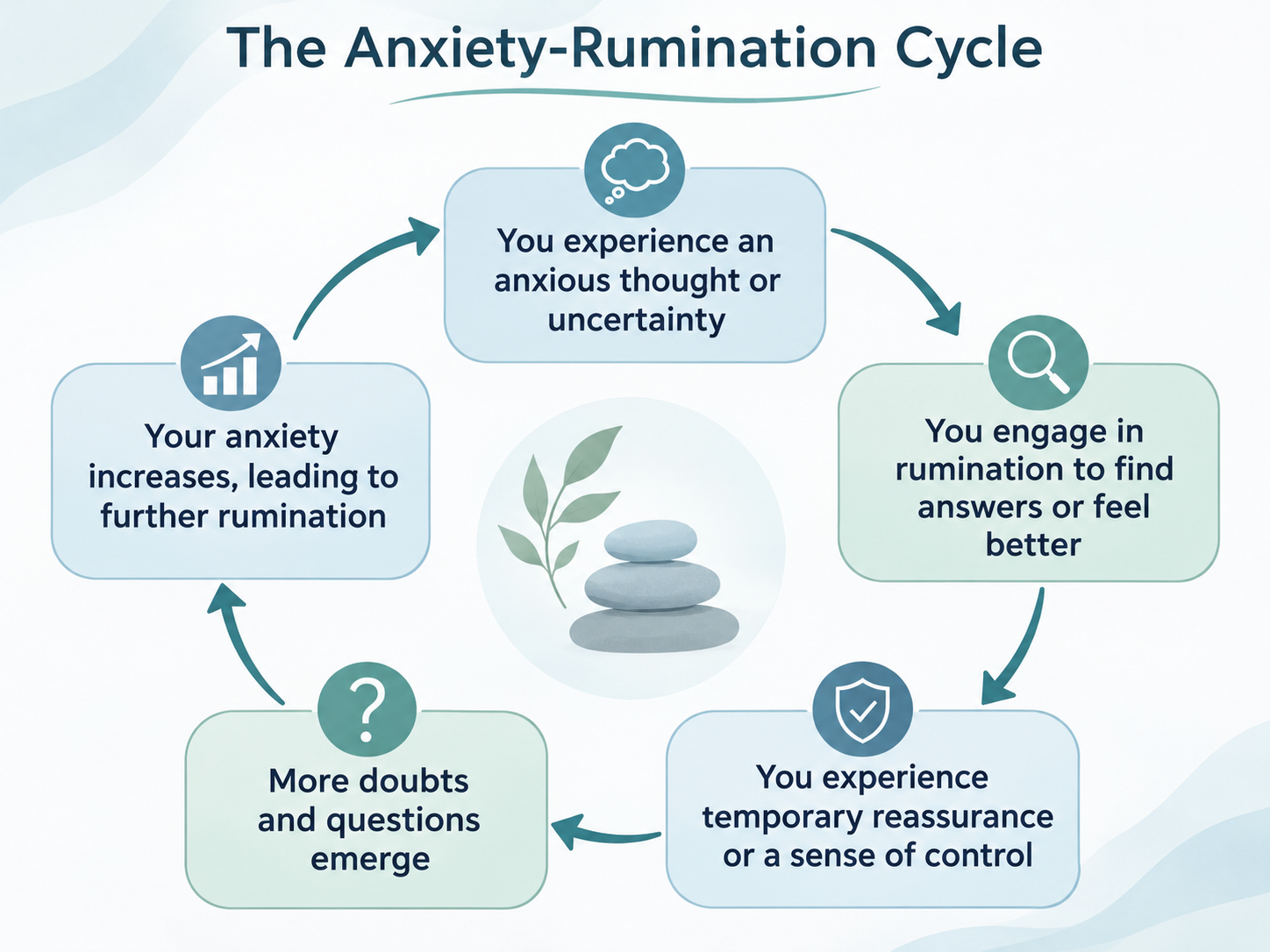
The difficulty is not necessarily the presence of anxious thoughts; instead, it’s the way you have learned to react to them. You may begin to believe that you must think through every possibility, fully understand your feelings, or reach an exact conclusion before you can move forward.
The encouraging news is that rumination is a learned pattern of responding to anxiety, and you can develop new skills to change that pattern

How Cognitive Behavioral Therapy (CBT) Can Help
Cognitive Behavioral Therapy (CBT) is an evidence-based treatment approach that can help you understand and change the thinking and behavioral patterns that maintain anxiety and rumination.
Rather than trying to eliminate uncomfortable thoughts or prevent anxiety altogether, CBT helps you develop a healthier and more flexible relationship with your thoughts. You learn that you do not need to answer every question, resolve every uncertainty, or engage with every anxious thought that enters your mind.
Through a collaborative and individualized treatment process, you can learn to:
Recognize rumination patterns. Become more aware of when your thinking has shifted from productive reflection or problem-solving into repetitive, anxiety-driven mental analysis.
Understand what maintains the cycle. Identify the situations, emotions, and beliefs that trigger rumination, as well as the ways repeated thinking may provide temporary relief while strengthening anxiety over time.
Develop greater cognitive flexibility. Learn to evaluate anxious predictions, challenge unhelpful assumptions, and consider alternative perspectives without getting caught in endless mental debates.
Increase your tolerance for uncertainty. Practice allowing questions to remain unanswered and recognize that you can make decisions, take action, and move forward without feeling completely certain.
Reduce unhelpful mental habits. Learn strategies for disengaging from excessive reviewing, overanalyzing, reassurance-seeking, and other patterns that keep you mentally stuck.
Shift from overthinking to meaningful action. Strengthen your ability to distinguish between problems that require practical action and concerns that are better addressed by allowing uncertainty and redirecting your attention.
Build confidence in managing anxiety. Develop the skills to respond to uncomfortable thoughts and feelings with greater flexibility, self-compassion, and trust in your ability to handle life's challenges.
Learning to Respond Differently to Your Thoughts
Through gradual, personalized practice, you can break out of this cycle. You can strengthen your ability to navigate uncertainty, make decisions, and return your attention to the activities and relationships that are meaningful to you.
Treatment is collaborative and skills-based, allowing you to practice new approaches at a pace that supports your learning and progress. Over time, these skills lower anxiety and increase your sense of confidence and emotional well-being.